
Designing a clearer ecommerce experience for a complex custom product.
CustomBoxes.io needed more than polished pages. The customer experience had to explain a technically complex product, make purchasing decisions easier, support repeat ordering, and connect brand, ecommerce, lifecycle marketing, AI-enabled workflows, and operations into one practical system.
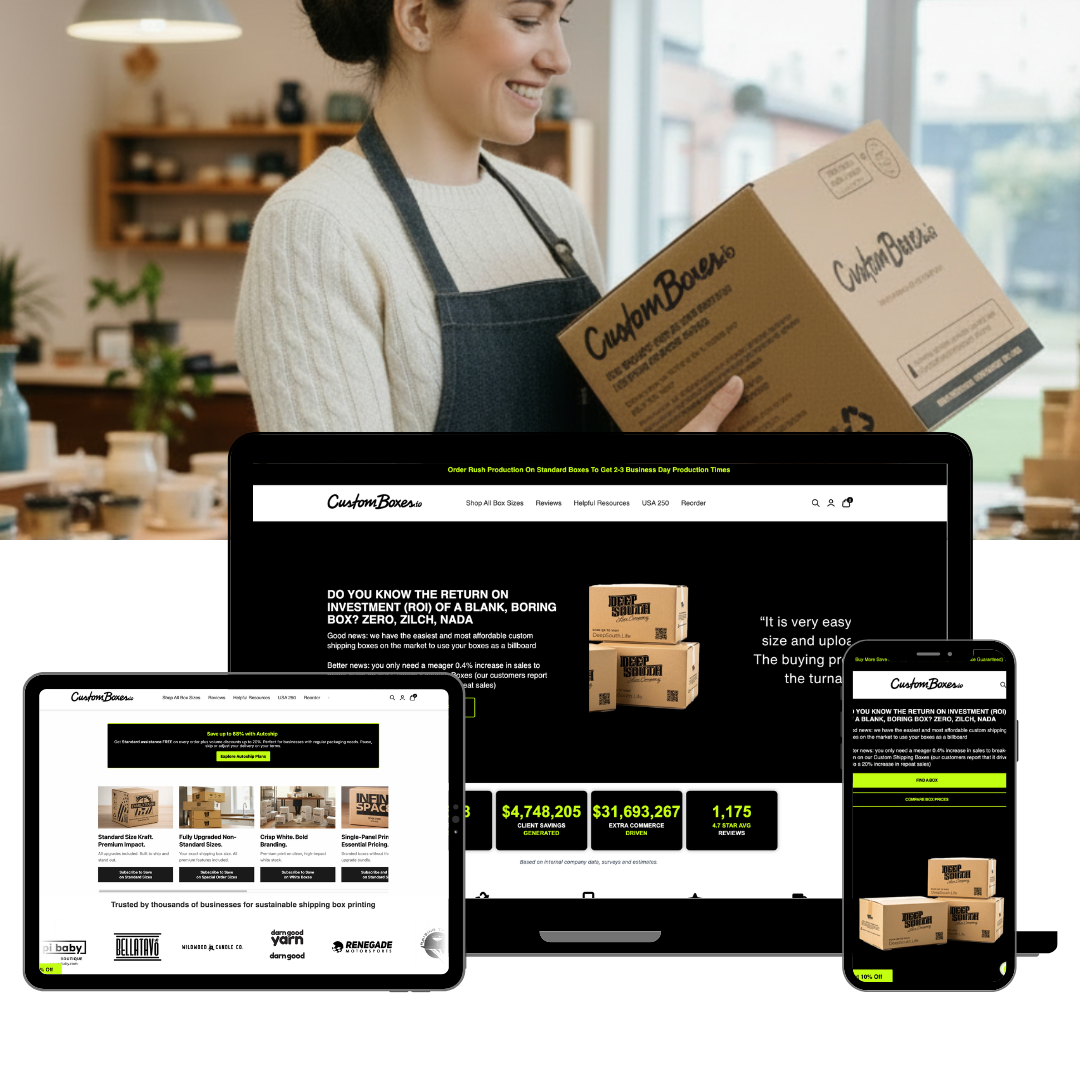
Customers were not just buying boxes. They were navigating uncertainty.
Custom packaging creates decision friction around size, artwork, proofing, lead times, print limitations, reorder timing, and the level of design support a business may need.
The site had to make those choices easier for customers while also supporting the realities of production, prepress, customer service, product management, and lifecycle marketing.
- Clarify the product offer and buying path
- Reduce friction between product discovery and purchase
- Make reordering and subscription options easier to understand
- Translate artwork and production rules into customer-facing guidance
- Connect landing pages with lifecycle marketing and retention paths
The site was treated as a connected business system, not a digital brochure.
Each design decision responded to a practical customer or operational need, including purchase clarity, product education, repeat ordering, retention, and smoother internal handoffs.
| Business Need | Design Response |
|---|---|
| Reduce purchase friction | Simplified product paths, clarified calls to action, and made buying intent easier to act on. |
| Strengthen customer retention | Connected landing pages, post-purchase messaging, reorder prompts, and subscription education into one lifecycle experience. |
| Support repeat purchasing | Treated reordering as a customer experience challenge, with clearer account, reorder, and subscription paths. |
| Scale customer education | Built automated journeys and self-service resources around artwork, proofing, product selection, and production expectations. |
| Improve product discovery | Used clearer page hierarchy, product grouping, trust cues, and more direct decision paths. |
| Reduce internal friction | Turned policies, artwork requirements, and production logic into clearer customer-facing content and repeatable workflows. |
Every page had to answer the buyer's next question.
The site structure was designed around decision clarity: what the product is, who it is for, what options exist, what help is available, and what the visitor should do next.
- Hero sections: clearer product promises, primary actions, and trust cues
- Product paths: standard sizes, custom sizes, mailers, cube boxes, white boxes, and subscription options
- Education: artwork guidance, design assistance, templates, lead times, and packaging strategy
- Retention: reorder prompts, subscription logic, repeat-purchase messaging, and lifecycle handoffs
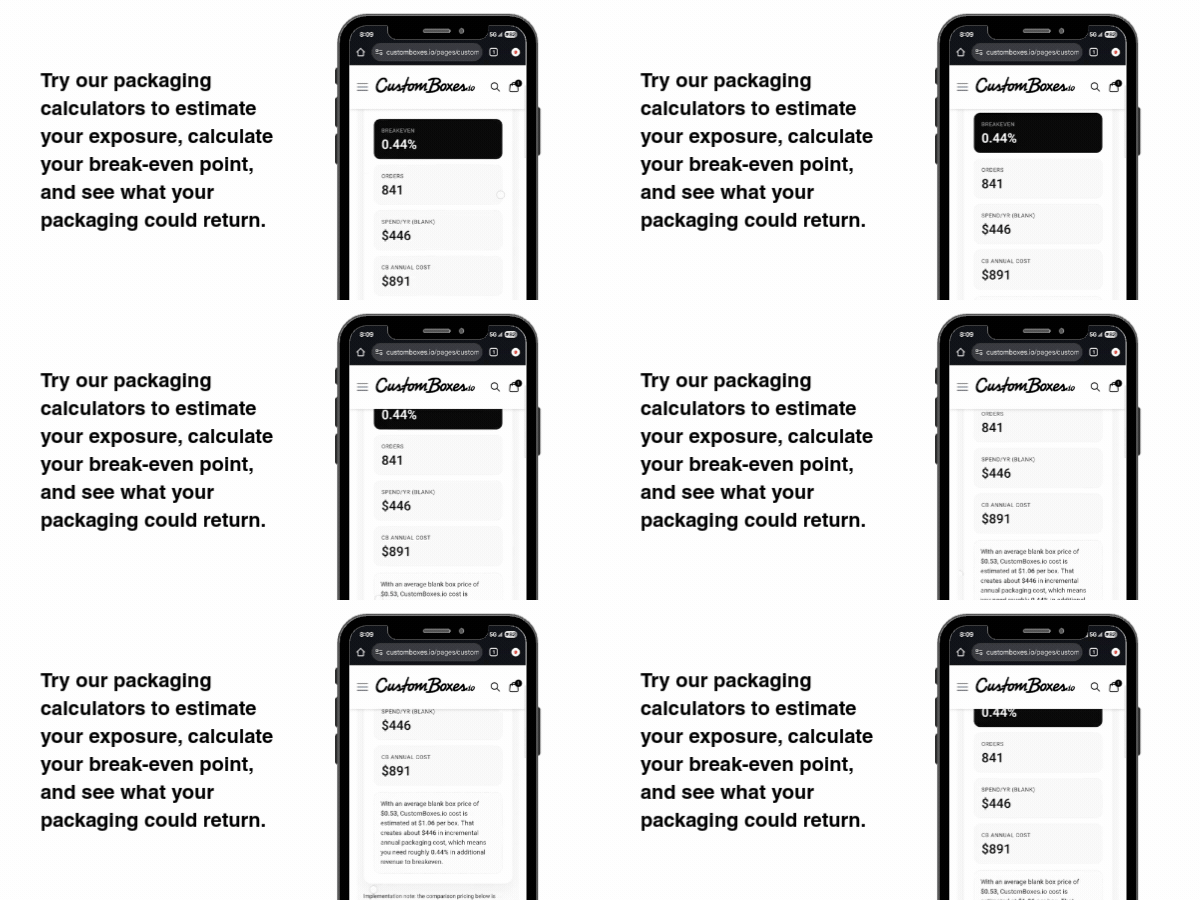
The visible customer experience was supported by operating systems underneath.
Creative Operations Framework
Built clearer priorities, decision gates, and operating rhythms around what needed to ship, what required attention, and where the team could reduce unnecessary work.
Lifecycle Marketing System
Connected Welcome, Post-Purchase, Reorder, Winback, subscription, and segmentation experiences so the website and email program worked as one customer journey.
AI Systems and Internal Tooling
Introduced practical AI-supported workflows for customer service, production design, prepress questions, campaign development, content creation, and internal decision support.
Tiered Shopify Commerce Experience
Developed a tiered packaging experience across different customer needs, product templates, artwork uploads, proofing paths, service levels, and launch quality assurance.
Partnership and GTM System
Built coordinated launch paths for partner initiatives, including landing pages, partner communication, customer campaigns, retargeting, and campaign tracking.
Production Quality Productization
Translated technical printing constraints into clearer service offerings around artwork review, production readiness, and best-available print setup.
Faster campaign production without losing brand direction.
AI-supported workflows accelerated concept development, product visualization, copy exploration, voice-over production, and campaign execution. Final hierarchy, brand decisions, customer journeys, and creative quality remained actively directed and reviewed.


Practical, high-contrast, fast-loading, and built for B2B buyers.
The design used CustomBoxes.io's black, white, gray, and hi-viz visual system to create a sharp, utilitarian experience. The goal was not decoration. It was making products, services, and next steps easier to understand.
A customer experience built to support continued growth.
The work connected ecommerce, lifecycle marketing, creative operations, AI-enabled workflows, product architecture, production requirements, and customer education into a more cohesive system. By aligning design with operational realities, the platform became easier to navigate, easier to manage, and better equipped to support customers as the business evolved.